How it works Pricing Craft Library Mac app
Log In Get Penn's read
SCRIPT NOTES

Honest notes on your draft.
In the margin. Tonight.

Penn reads the whole script, marks what is not working next to the line, and argues back when you push. On every draft. Not a $100 evaluation two weeks out. Not a chatbot that flatters you and rewrites your scene.

Paste the scene that is fighting you. Or the logline. Penn reads it now.

Free. No account. We never train on your writing or share it. Try it on a sample scene

Penn's read

That is one note on one paste. On the desk, Penn reads the whole draft, remembers it, and argues back when you disagree.

Get notes on the whole draft →
Free to start. No card. Your pages stay yours.
Penn is an AI reader. It never writes your pages and never trains on them. Every note is about your scene, not a template.
Built by writers and filmmakers Grounded in 91 screenplay analyses Your pages stay yours, never used for training
Within the rules

The WGA and the Academy drew the line at AI authorship.
Better Draft lives on the human side of it.

Penn is a reader, not a ghostwriter. It reads your pages and leaves honest notes in the margin. Your script stays human-authored from FADE IN to FADE OUT, and we never train on your work.

What you do instead

You have ninety pages and nobody honest to show them to.

Final Draft formats your script. It has watched a million scripts die on page 32 without saying a word. What is still unsolved is the read.

THE $100 EVALUATION

Two weeks. One pass. A number.

You get a report after you have stopped working on the draft. It cannot follow you into the rewrite, and you cannot ask it a question.

THE CHATBOT

It tells you the draft is great. Then it rewrites it.

No page memory, no craft, no spine. Paste a scene and it hands you back a different scene with your name on it.

THE FRIEND

Never gets to it. Too kind when they do.

A reader who owes you a swap, has not read past page 30, and is not going to tell you the second act sags.

How it works

1

Paste your pages

A scene, an act, the whole draft. Fountain, Final Draft, or plain text. Penn reads every page and holds the whole script in mind.

2

Read the notes in the margin

Each note sits next to the line it is about. What is working, what is not, and the question that cracks it open. Specific, never generic.

3

Argue back, then rewrite

Push on a note and Penn defends it or concedes. Change the page and the next read remembers what you changed. Every draft, not once.

A real Penn note on a real page. Then you decide.

Judge the taste, not the pitch

We do not have a wall of praise yet. We have the notes. Both of these are Penn's real, unedited reads of sample pages. Paste your own above and hold it to the same standard.

ON A HOSPITAL WAITING ROOM SCENE, 3 AM, A MAN STALLING ON A FORM

"The last line is the thing. 'Is it bad. Just tell me the word people use when it is not bad.' That is a man who cannot hold grammar together anymore, asking for a script to survive the next thirty seconds. The period instead of a question mark does real work. [...] The form is where his control is dying in real time, and right now it is doing about 80% of what it could do."

Penn, on sample pages
ON A USED CAR LOT SCENE, $400 AND A JOB INTERVIEW ON THURSDAY

"Mira getting in anyway despite the smell is the scene's emotional core, the moment where desperation and determination meet, but it's doing its work silently while the scene's energy is still on Glenn. Ask yourself what that closed car door changes. She's now alone, separated from him by glass. Does she do something in there, even small, that Glenn can't see?"

Penn, on sample pages

What a reader should do

Everything here is a read of your work. None of it writes your pages.

01

Notes on the line

Not a report at the end. A note in the margin, next to the line it is about, while you are still in the scene.

02

Remembers the whole script

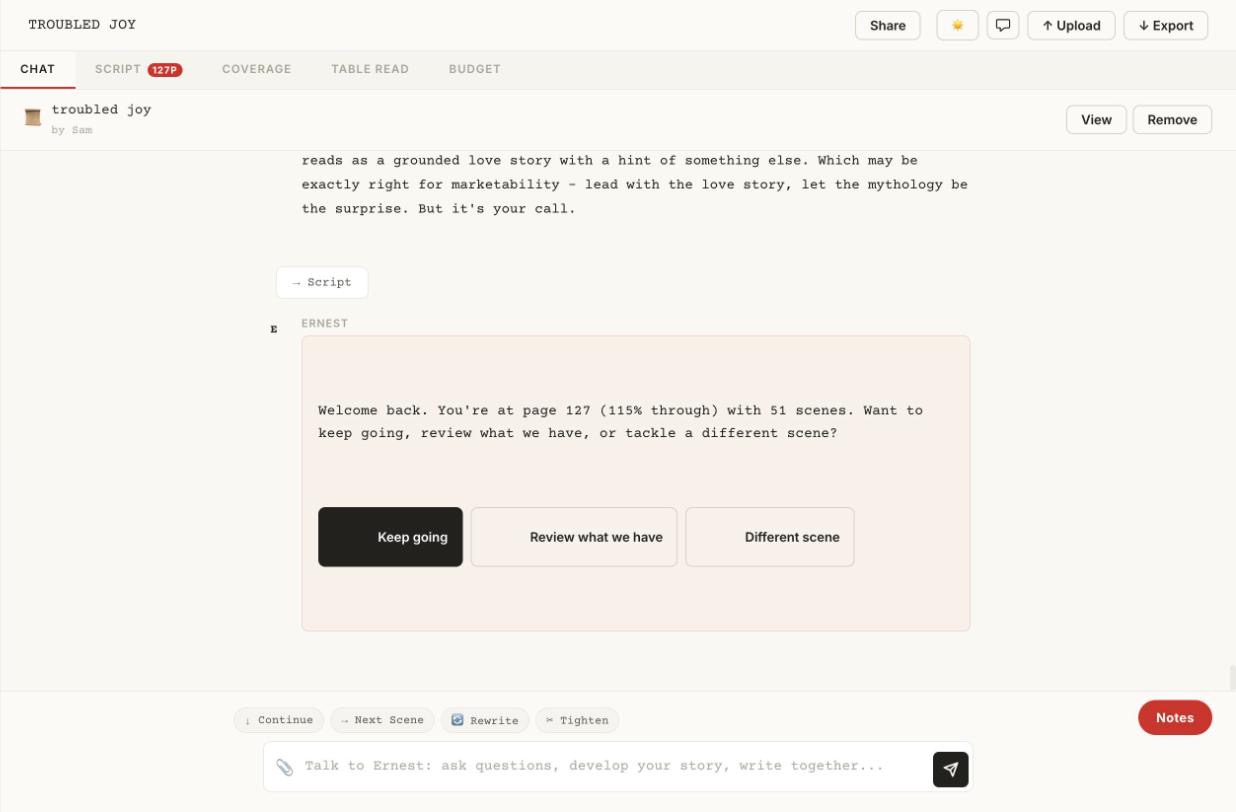
Penn keeps a bible of your characters, promises and threads. A note on page 80 knows what you set up on page 4.

03

Argues back

Disagree with a note and say so. Penn holds its ground when it is right and concedes when you are. A conversation, not a verdict.

04

Full coverage when it is ready

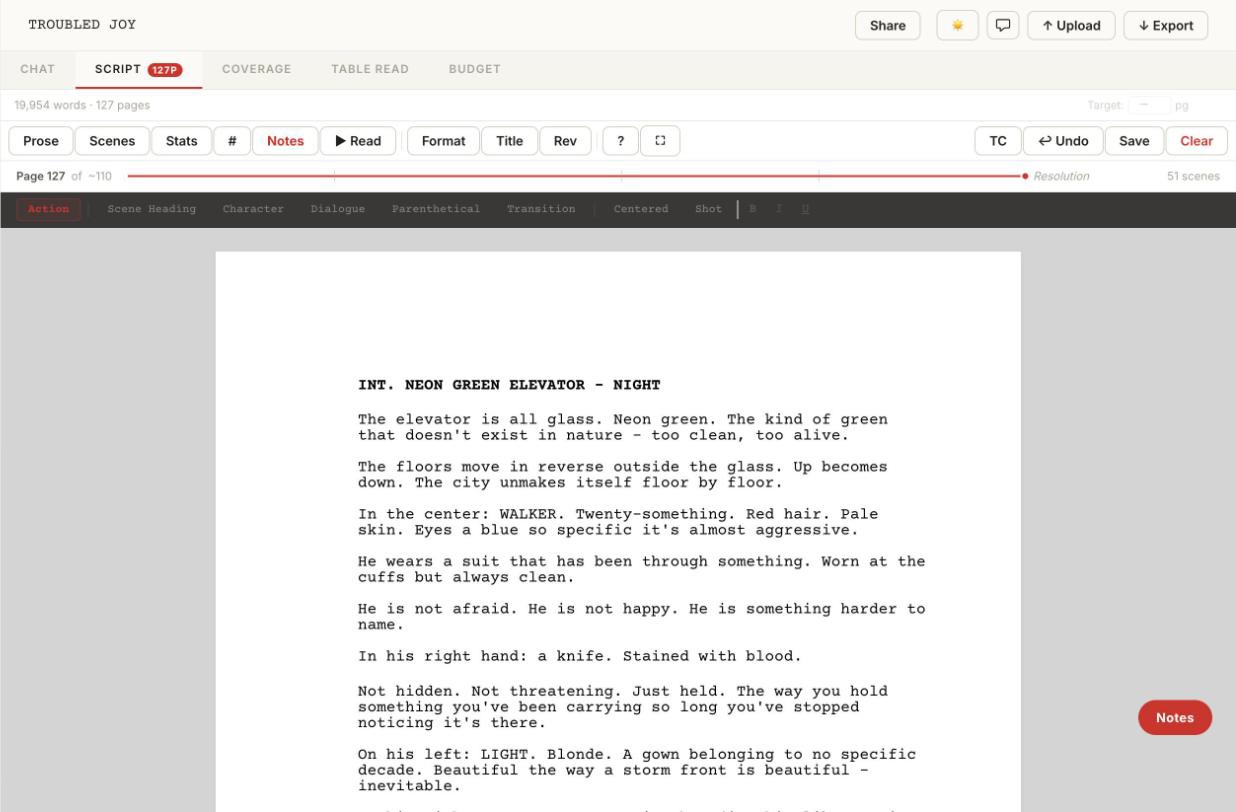
A complete read with structure, character, dialogue and a prioritized rewrite plan. In minutes, on every draft.

05

Craft library

Analyses of 91 produced screenplays. When a note says a scene is a memo, it can show you how a produced script solved the same problem.

06

Hear it read

A table read of your pages, performed aloud. The fastest way to find the line that does not sound like a person.
For screenwriters in the rewrite

You have a draft. Maybe a first one, maybe a fourth. You know something in the middle is not working and you are tired of guessing which thing. You have priced coverage and put it off. The people who offered to read it have not.

Better Draft is for that week. Paste the pages, get the notes tonight, argue with the ones you disagree with, and go back into the draft knowing what to fix. Draft after draft, until the script is ready for the rep, the contest, or the producer who said send it when it is done. If you are still at the logline, the free read above works for that too. The rest of the desk earns its keep once there are pages.

The questions writers ask first

Can I push back on notes I disagree with?
Yes, and you should. Tell Penn why the note is wrong and it defends the note or concedes. The argument is the point.

Will this compromise my authorship?
No. Penn is an AI reader. It never writes your pages. Notes are not authorship; Nicholl and Austin ban AI-generated pages, not AI-read pages.

Will my script train your AI?
Never. Your pages are never trained on and never shared. You own everything you write, 100%.

Why not just pay $100 for one human read?
Do that too, on the final draft. Better Draft is for the six drafts before it: notes tonight, on every draft, for less per month than one read.

Can an AI really hold a 90-page script?
Penn keeps a bible of characters, promises, and threads. A note on page 80 knows what you set up on page 4. Paste a scene above and judge the taste yourself.

Why we built Better Draft

We are writers and filmmakers. Every script we finished, we finished because someone in the room read it honestly and early. Most writers never get that room.

So we built a reader. Not a writer. Penn tells you what is not working and why, and leaves the pen in your hand. You are the author. You always will be.

Better Draft Notes, on your phone

A separate, smaller thing. Your ideas do not keep office hours.

Capture the line, the fix, the idea, the moment it hits. Speak it or snap it. It lands on the desk, filed to the right script, ready for your next session at the computer.

Open Better Draft Notes →

The desk, on your Mac.

A native app, signed and notarized by Apple.

Your scripts live on your machine as real files, it opens in a second, and your work is there even when the wifi is not. Same account, same Penn, same notes.

Download for Mac

Free with your account · Apple Silicon and Intel · macOS 12+

Less than one coverage read. Every draft you write.

Free to start, no card. Plans from $16 a month. Launch prices locked for 12 months.

See pricing →

Your draft. Read tonight.

Paste the pages. Get the notes. Argue back. Rewrite.

Get Penn's read → Already have an account? Log in

Free to start, no card. 30-day money-back guarantee: if Penn's notes do not help your draft, email us and we refund you, no questions asked. Your scripts stay private: we never train on your work or share it with anyone. Read our promise →